 Try Onsa
TL;DR: Vibe prospecting is a new approach to B2B lead generation where you describe your ideal customer in plain English — their challenges, goals, and context — and AI agents find matching prospects through real-time research. Unlike traditional prospecting, it uses natural language instead of filters and databases.
Vibe prospecting is the practice of describing your ideal customer in natural language and letting AI agents handle the research, qualification, and outreach autonomously. Instead of manually configuring filters in a sales database, you express intent — “who are you looking for and why” — and AI does the execution. The term follows the pattern of “vibe coding,” coined by Andrej Karpathy in February 2025, where the core skill shifts from tool operation to judgment and direction.
If you’ve used Apollo, ZoomInfo, or LinkedIn Sales Navigator, you know the drill: learn the filters, build boolean queries, pull lists, manually verify, enrich data, write messages. That workflow takes 6-8 hours before a single email goes out.
Vibe prospecting replaces that entire sequence with three steps: describe your customer, review the leads AI finds, approve and send. The time drops from hours to minutes. But the bigger change isn’t speed — it’s who can do it. You no longer need to be a sales ops expert. You need to know your customer.
I’ve been building in this space for the past year. Here’s what I’ve learned about how vibe prospecting works, where it fits, and where it falls short.
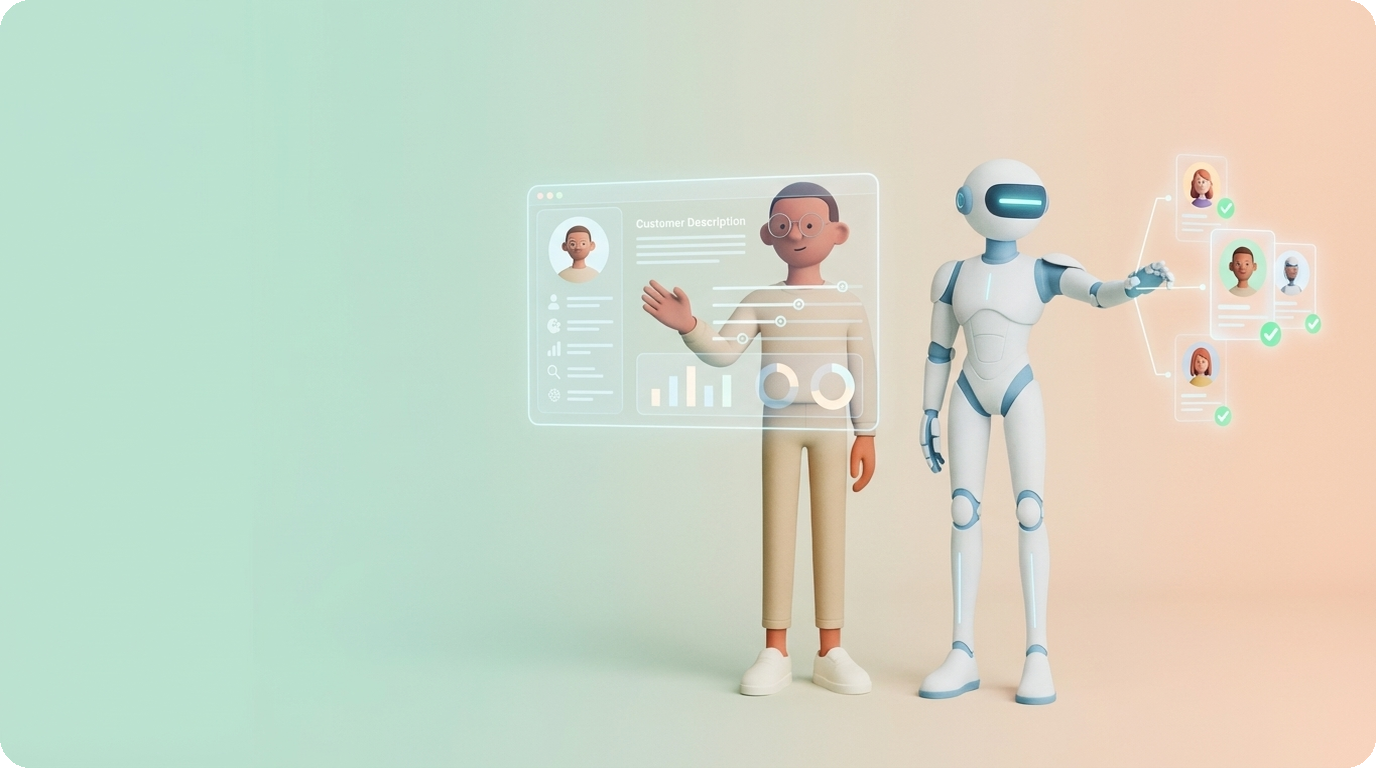
The workflow has three stages, and understanding each one explains why this is a structural change, not just a faster version of the old process.
You start with a natural language description of who you’re looking for. This can be as simple as a sentence:
“Series A fintech companies in the US, 20-50 employees, that recently hired their first Head of Sales.”
Or it can be a URL. Paste your best customer’s website, and the AI reverse-engineers the profile: what industry they’re in, what size they are, what signals made them a good fit, and what other companies share those characteristics.
The key difference from traditional tools: you don’t need to translate your customer knowledge into filter logic. You don’t need to know which SIC code maps to “fintech platforms” or which Apollo filter captures “recently hired.” You express what you know in the language you think in.
This is exactly what we do at Onsa — our AI agents take a natural language description and build a structured ICP from it automatically.
This is where vibe prospecting diverges most from traditional approaches.
In a database tool, you get back whatever matches your filters. If your filters are slightly off, the results are garbage. If the data is stale (and it often is — we found roughly 30% of Apollo contact data was outdated within months), you waste time on dead leads.
In vibe prospecting, AI agents actively research from live sources: company websites, LinkedIn profiles, public filings, news articles, job postings, industry registries. They don’t just pattern-match against a static database. They read, synthesize, and qualify.
Each lead comes back with context: why this company matches, what they do, what signals triggered the match, who the right contact is, and what’s relevant to mention in outreach. This is research that would take a human SDR 15-30 minutes per lead. The AI does it in seconds.
You get a list of qualified leads with draft messages. Your job is judgment: does this look right? Is this the kind of company I want to talk to? Does the outreach message reference something real and relevant?
If a lead doesn’t fit, you say why. The AI adjusts its criteria and finds better matches. This feedback loop is continuous — the more you review, the sharper the targeting gets.
This is the “vibe” in vibe prospecting. Like vibe coding, you’re directing, not executing. The skill isn’t operating a tool — it’s knowing what good looks like.
“Vibe coding” was coined by Andrej Karpathy in a February 2025 tweet. The idea: you describe what you want a program to do, AI writes the code, and you guide it through iteration. You don’t write syntax. You describe intent and evaluate results.
The concept went mainstream fast. Y Combinator started accepting vibe-coded startups. Developers debated whether it was the future or the end of engineering standards. But the underlying shift was undeniable: the barrier to building software dropped from “can you write React?” to “can you describe what you need?”
Vibe prospecting applies the same pattern to sales. The barrier to finding qualified leads drops from “can you operate Apollo’s 47 filters?” to “can you describe your ideal customer?”
We wrote a longer piece about how this shift plays out in practice, including why we almost called our product “vibe sales” before a VP of Sales talked us out of it.

The differences are structural, not just incremental.
How you define targets. Traditional: translate your ICP into filter combinations — industry codes, employee ranges, revenue brackets, job titles. You think in the tool’s language. Vibe prospecting: describe what you actually want. “Mid-size logistics companies in the Midwest still managing dispatch with spreadsheets.” The AI operationalizes your description.
Data source. Traditional: static databases updated periodically. People change jobs, companies pivot, the data decays. Vibe prospecting: live research at the moment you search. Company websites, LinkedIn, public registries, news — pulled in real time.
Skill required. Traditional: rewards tool expertise. The person who knows boolean syntax and API integrations gets better results. Vibe prospecting: rewards customer knowledge. Domain experts and founders often outperform trained SDRs because they have deeper insight into what makes a good customer.
Time to first outreach. Traditional: hours to days for a quality list. Vibe prospecting: minutes. Not because corners are cut, but because sequential manual steps happen in parallel, autonomously.
Personalization. Traditional: template-based with light variable swaps (first name, company name, maybe a recent LinkedIn post). Vibe prospecting: each message reflects actual research — the prospect’s tech stack, recent funding, hiring patterns, published content. The message sounds like someone spent 20 minutes on LinkedIn. No one did.
Feedback mechanism. Traditional: you adjust filters based on results, which means going back to the tool and rebuilding queries. Vibe prospecting: you approve or reject leads with a reason, and the AI adjusts its criteria automatically. The system learns from your judgment.
It’s not magic. It works best in specific situations where traditional tools hit their limits.
Niche ICPs that don’t fit standard filters. One of our customers sells drone management software for construction companies. Their real ICP: companies with licensed commercial drone operators. Try finding that in Apollo. You’d search “construction companies,” filter by size, and hope. Our agents found the FAA’s public registry of licensed operators and expanded from there — company websites, drone pilot employees, LinkedIn profiles. The difference isn’t speed. It’s precision.
Founders doing their own sales. Most founders hate prospecting because the tooling has a steep learning curve. You shouldn’t need to spend two weeks mastering Apollo’s interface when you could spend that time talking to customers. If you can describe your ideal customer in a few sentences, you can find leads — no filter expertise required.
Entering new markets. When you’re expanding into a new geography or vertical, you don’t have historical data to filter on. You don’t know the right SIC codes or job titles. You have a hypothesis: “mid-size manufacturing companies in Germany digitizing their supply chain.” Vibe prospecting lets you test that hypothesis immediately instead of spending weeks building filter sets from scratch.
Multi-signal ICPs. Some ideal customer definitions combine signals from multiple sources: funding stage + hiring velocity + technology stack + geographic presence. No single database captures all of these. Traditionally you’d pull from Crunchbase, LinkedIn, BuiltWith, and company websites separately, then cross-reference in a spreadsheet. AI agents do this natively — they pull from multiple sources and synthesize.
When data freshness matters. If you’re targeting companies that just raised a round, just hired a specific role, or just launched a product, static databases are always behind. Vibe prospecting catches signals that are days old, not months.
Vibe prospecting isn’t always the right tool.
High-volume spray-and-pray. If your strategy is emailing 10,000 contacts a month with light personalization, a database tool with bulk export is more efficient. Vibe prospecting is built for quality over quantity — 50 well-researched leads beat 500 unqualified ones, but only if your product and deal size support that approach.
Simple, well-defined ICPs. If your ICP is “VP of Engineering at US SaaS companies, 100-500 employees” — congratulations, that’s a standard filter in any database. You don’t need AI to find them. Use the filter.
Industries with complete database coverage. Some verticals are well-covered by existing databases — tech, finance, professional services. If your targets are all on LinkedIn with accurate titles and your ICP maps cleanly to standard filters, the marginal benefit of live research is lower.
A vibe prospecting workflow needs three capabilities:
1. Natural language ICP input. The tool must understand unstructured descriptions, not just form fields. “Companies like Stripe but earlier stage” should work as input.
2. Live multi-source research. The AI must pull from diverse sources — not just one database. Company websites, LinkedIn, public registries, news, job postings. This is what separates vibe prospecting from “AI-enhanced database search.”
3. Contextual outreach generation. Messages must reflect the research, not just the template. If the AI found that a company just opened a London office, the outreach should reference that — without you having to add it manually.
Onsa is purpose-built for this workflow. But the concept is bigger than any single tool — it’s a shift in how prospecting works.
If you want to try the approach:
1. Write down your ideal customer in 3-4 sentences. Not in filter language. In the language you’d use to explain to a friend who your best customers are and why they buy.
2. Include the “why” signals. Go beyond firmographics (size, industry). What behavior or situation makes someone a good customer right now? Recent funding? A specific hire? A technology decision? A competitive switch?
3. Start with your best existing customer. Paste their website URL. See what profile the AI builds. Then say “find more like this.”
4. Review the first 5 leads with attention. Don’t auto-approve. Read the research summaries. Check if the “why this lead” explanation makes sense. Your feedback on these first leads shapes everything after.
5. Iterate your description, not your filters. When results aren’t right, adjust your language. “These are too small” or “I need companies that are already using AI, not exploring it.” The AI translates your feedback into better targeting.
The whole process should take under 30 minutes to get your first qualified list.
What is vibe prospecting? Vibe prospecting is describing your ideal customer in natural language and letting AI agents handle research, qualification, and outreach autonomously. The term follows the pattern of “vibe coding” — the core skill shifts from operating sales databases to directing AI with your customer knowledge. Instead of configuring filters, you describe intent.
How is vibe prospecting different from using AI in sales? Most “AI in sales” today means using ChatGPT to write emails or summarize research you already gathered. Vibe prospecting is different — the AI does the entire research process: finding companies, qualifying them against your criteria, identifying decision-makers, and drafting personalized outreach. You describe the target, not the steps. Our interviews with 36 sales professionals showed that most teams are still in the “AI as faster search bar” phase. Vibe prospecting is the next step.
Does vibe prospecting replace sales reps? No. It replaces the 6-8 hours of manual research and tool-switching that happens before any selling starts. The rep still reviews leads, runs discovery calls, handles objections, and closes deals. The skill shifts from data entry to judgment — which is what good salespeople are actually trained for.
What tools support vibe prospecting? Onsa is built specifically for this workflow — natural language ICP input, live multi-source research, and contextual outreach generation. Some other AI sales tools are adding natural language features on top of traditional database architectures. The key differentiator is whether the tool starts from your description or still requires you to think in filters.
Is vibe prospecting accurate? What about data quality? Live research from multiple sources tends to be more current than static databases, where data decays significantly within months. The trade-off: vibe prospecting is slower per-lead than a bulk database export. Each lead gets individually researched. For most B2B sales motions where quality matters more than volume, this is the right trade-off.
Can I use vibe prospecting without a sales background? That’s exactly the point. If you can describe your ideal customer in a few sentences, you can generate qualified leads. Founders and domain experts often produce better results than trained SDRs because vibe prospecting rewards customer knowledge, not tool expertise.
What is the difference between “vibe sales” and “vibe prospecting”? “Vibe sales” is a broader (and vaguer) term that could apply to any AI-assisted selling activity. “Vibe prospecting” is more precise — it refers specifically to the shift in lead generation from filter-based database queries to natural language intent-driven search. We wrote about why we chose the more specific term and why memes don’t make moats.
How long does vibe prospecting take compared to traditional outbound? Traditional prospecting: 6-8 hours to build a quality list of 20-30 leads with personalized messages. Vibe prospecting: 15-30 minutes for the same output. The biggest time savings come from eliminating the manual research step (15-30 minutes per lead × 20 leads = 5-10 hours saved).
I’m Bayram, co-founder of Onsa. We’re building AI agents for B2B sales that let you describe your customer instead of operating databases. If you have questions about vibe prospecting or want to share your experience, reach out — bayram@onsa.ai.