 Try Onsa
TL;DR: Anthropic's 2025 research measured AI exposure across 1,000+ occupations. Sales roles show 96-100% task exposure for lead qualification, research, and outreach — confirming these are the first tasks to automate. But only 28% of sales tasks can be fully automated; the rest need human judgment.
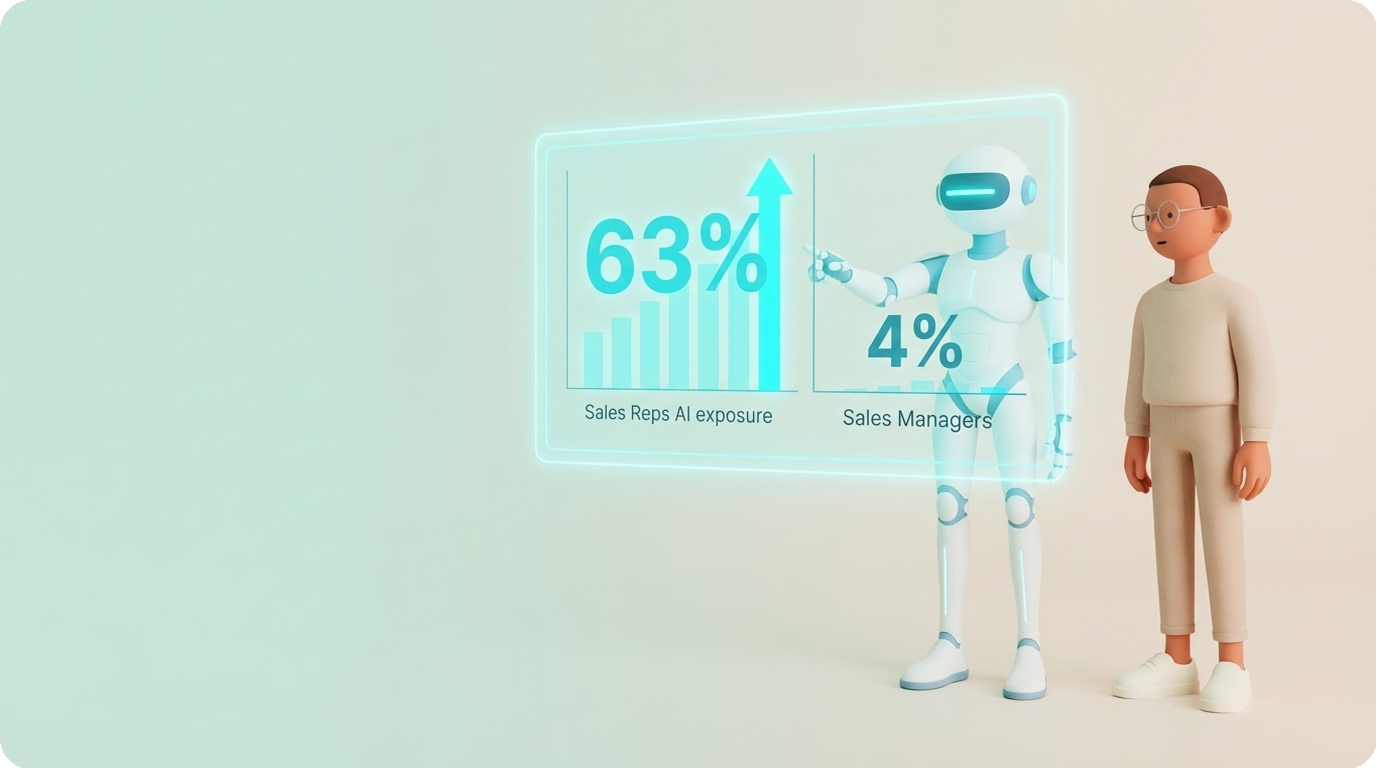
Anthropic's March 2026 labor market study analyzed 756 occupations using real Claude usage data — not theoretical capabilities. Sales Representatives hit 63% AI task exposure (top 11 across all professions), while Sales Managers sit at just 4%. The pattern: prospecting and research are near-100% automated. Negotiation tasks are at 0%. This is the first large-scale empirical data on which sales tasks AI actually handles in production.
Sales Reps are among the most AI-exposed professions in America. Sales Managers are among the least.
Same department. Same company. Same technology. Opposite exposure.
That's the headline finding from Anthropic's new research paper, "Labor market impacts of AI," released in March 2026. But the details underneath — the specific tasks, the exact percentages, the patterns that emerge — tell a much more nuanced story than "AI is coming for sales jobs."
I dug into the dataset and pulled every sales-related profession. Here's what the data actually says.
Most AI impact studies are theoretical. Researchers look at job descriptions, assess which tasks could potentially be done by AI, and assign a score. The problem: "could" and "does" are very different things.
Anthropic introduced a new metric they call "observed exposure." Instead of asking "what could AI do?", they measured what people actually automate through Claude right now. They matched real usage patterns against O*NET task descriptions for 756 occupations.
The gap between theory and practice is enormous. In Computer & Math occupations, theoretical AI coverage is 94%. Observed exposure: 33%. Two-thirds of what AI could automate, people aren't actually automating yet.
For sales, the gap is just as revealing — and the variation across sales roles is where it gets interesting.
Here's every sales-related occupation in the dataset, ranked by observed AI exposure:
Market Research Analysts: 65% — The most exposed. AI handles catalog coordination (98%), market positioning research (98%), consumer analysis (96%), and demographic data collection (96%). What it doesn't touch: measuring customer satisfaction, monitoring industry trends, or directing survey teams.
Sales Representatives, Non-Technical: 63% — In the top 11 most exposed professions across all 756 occupations. AI recommends products (100%), does post-sale support (100%), contacts prospects (99%), and identifies new customers (98%). What remains human: negotiating shelf positioning, negotiating contract details, stocking displays.
Securities & Financial Sales: 44% — AI executes trades (100%), contacts prospects (98%), monitors markets (98%), and tracks price factors (97%). What stays human: making bids, agreeing on prices, keeping transaction records.
Sales Engineers: 32% — AI documents accounts (97%), collaborates with sales teams (97%), and researches potential customers (97%). What stays human: visiting prospects in person, creating service contracts, keeping up with industry trends.
Insurance Sales: 32% — AI interviews prospective clients (99%), seeks new clients (96%), and confers on claims (92%). What stays human: explaining policy features face-to-face, performing admin tasks, contacting underwriters.
Retail Sales: 32% — AI handles merchandising (100%), product recommendations (99%), and product descriptions (96%). What stays human: greeting customers, processing payments, demonstrating products.
Telemarketers: 29% — AI contacts businesses (100%), schedules appointments (100%), obtains customer information (99%), and explains products (96%). What stays human: maintaining records, answering inbound calls, delivering scripted sales talks.
Real Estate Sales: 28% — AI compiles listings (100%), interviews clients (99%), coordinates appointments (99%), and generates property lists (98%). What stays human: preparing contracts, presenting offers, coordinating closings.
Sales Reps, Technical: 27% — AI prepares contracts (100%), maintains records (100%), selects products (100%), and informs on delivery (100%). What stays human: visiting establishments, quoting prices, emphasizing product features based on customer analysis.
First-Line Supervisors, Retail: 26% — AI monitors sales activities (100%), examines merchandise (99%), and provides customer service (96%). What stays human: directing employees, assigning duties, reviewing inventory.
First-Line Supervisors, Non-Retail: 23% — Similar pattern. AI monitors performance and resolves complaints. Humans direct, hire, train, and schedule.
Advertising Sales: 15% — AI studies client needs (98%) and prepares presentations (92%). What stays human: maintaining accounts, estimating costs, locating potential clients, explaining ad types.
Sales Managers: 4% — Only one task shows meaningful automation: resolving customer complaints (98%). Everything else — directing sales activities, overseeing regional managers, setting price schedules, planning staffing, preparing budgets — is at 0%.

Three patterns jump out when you look at the data across all sales roles:
Pattern 1: Prospecting and research are near-100% automated.
Every sales occupation has "contact prospects" or "identify customers" or "research clients" tasks. In every case, these are among the most automated — typically 96-100% observed exposure. AI is already doing this work at scale.
This matches what we see with our users at Onsa. The research, qualification, and initial outreach that used to take hours per lead is exactly what AI handles best. It's structured, it's repeatable, and speed matters.
Pattern 2: The Negotiate Zero.
I searched the entire dataset — all 756 occupations — for every task containing "negotiate." Out of 30 negotiate-related tasks across the economy, 25 have 0% observed exposure. That's not a rounding error. That's a wall.
The few exceptions prove the rule: real estate intermediation (93%) and standardized price negotiation (97%) — cases where the "negotiation" is really information relay, not persuasion. When negotiation requires reading the room, building trust, or crafting creative deal structures, AI exposure drops to zero.
Every sales leader who's wondered "will AI replace my closers?" now has an empirical answer: not yet, and probably not soon. The tasks that define senior sales work — navigating politics, structuring complex deals, negotiating terms — show zero real-world automation.
Pattern 3: The Management Inversion.
Sales Managers are at 4% exposure. The people they manage are at 63%. This is the most dramatic gap in any department.
Why? Because management tasks are almost entirely about directing, coordinating, overseeing, and developing people. "Oversee regional and local sales managers." "Plan and direct staffing and training." "Determine price schedules and discount rates." These aren't knowledge tasks — they're judgment-and-authority tasks. AI has no observed penetration.
This inverts the usual automation anxiety. It's not the senior people who should worry. It's the junior roles doing structured, repeatable work.
The paper found something quietly alarming: hiring of 22-25 year olds in AI-exposed professions dropped 14%. Not layoffs — just fewer new hires.
This matches a Stanford study from 2025 that found a 13% decline in junior developer hiring. The pattern is consistent across exposed professions: companies aren't firing experienced people, they're not backfilling entry-level positions.
For sales specifically, this means the traditional SDR-to-AE career ladder may compress. If AI handles the research, qualification, and initial outreach that SDRs do, the entry point into sales shifts. Junior reps need to develop relationship and negotiation skills faster, because the grunt work that used to be their on-ramp is disappearing.
We wrote about this dynamic in our analysis of task-level automation. The Digitalist Papers research — studying US labor data from 1980 to 2018 — showed that when routine tasks get automated, expert work becomes more valuable. Anthropic's data confirms this is happening right now in sales.
The Telegram post where I first broke down this data referenced a framework from Digitalist Papers that I think is essential here.
When computers automated routine tasks for accountants (data entry, calculations), accountant wages went up. The expert work — judgment, advisory, interpretation — became more valuable.
When computers automated expert tasks for warehouse workers (knowing where things are stored, navigating layouts efficiently), wages went down. The barrier to entry dropped because the specialized knowledge was no longer needed.
Apply this to sales: AI is automating the routine tasks — research, data entry, prospecting, initial outreach. The expert tasks — negotiation, relationship building, complex deal structuring — show 0% automation.
By the Digitalist Papers framework, this should increase the value of expert sales work. And anecdotally, that's exactly what we're seeing: top closers commanding larger premiums while SDR budgets face pressure.
This data also validates what companies like Vercel demonstrated in practice. They replaced 9 of 10 inbound SDRs with an AI qualification agent — same conversion rate, built by one engineer in six weeks.
Vercel didn't touch their AE team. They didn't automate negotiations or relationship management. They automated qualification — exactly the kind of structured, repeatable task that shows 96-100% exposure in Anthropic's data.
The 9 SDRs moved to outbound, where creativity and persistence matter. The pattern fits perfectly: automate routine, amplify expertise.
C.H. Robinson did the same with freight quotes — 2,000 daily quotes automated, stock jumped 20%. Again: high-volume, structured, speed-sensitive tasks. Not negotiations. Not relationships.
1. Audit your team's task distribution. List every task your sales team does. Map each one against the Anthropic data. If your reps spend 60% of their time on tasks with 95%+ AI exposure, that's your automation priority.
2. Protect the negotiate zone. The data is clear: negotiation, relationship building, and creative deal structuring are the highest-value skills in sales right now. Invest in developing these in your team. Don't let AI savings lead to cutting training budgets for the skills that matter most.
3. Rethink the SDR role. If research and initial outreach are 96-100% automated, the traditional SDR model needs updating. Either the role evolves toward higher-judgment work (complex qualification, relationship warm-up) or it gets absorbed by AI with human oversight.
4. Watch the junior pipeline. The -14% hiring effect for young workers is a leading indicator. If your company stops hiring junior sales roles, you'll have a talent gap in 3-5 years when those people would have become your mid-level and senior sellers. Plan for it.
5. Use the data in vendor conversations. When an AI sales tool tells you they'll "revolutionize your sales process," check their claims against the Anthropic data. If they promise to automate negotiation or complex deal management, they're selling fiction. The empirical data says zero.
Out of 756 occupations, 411 — more than half — have 0% observed AI exposure. Cooks, bartenders, lifeguards, most healthcare workers, most tradespeople. AI isn't touching them at all.
Only 11 occupations are above 50%. Sales Reps (non-technical) is one of them.
That makes sales one of the most affected professions in the economy — but affected in a specific way. The routine work is being automated. The expert work is not. And the gap between the two is widening.
For sales leaders, this isn't a threat. It's a reallocation. The same budget that funded 10 people doing research can now fund 3 people doing research oversight and 7 people doing the relationship and negotiation work that actually closes deals.
The teams that understand this — that read the data instead of the headlines — will build the sales organizations that win.
Which sales roles have the highest AI exposure?
According to Anthropic's March 2026 labor market study, Sales Representatives (non-technical) have 63% observed AI task exposure — ranking in the top 11 most exposed occupations out of 756 analyzed. Market Research Analysts are at 65%. Both are higher than most tech professions.
What sales tasks does AI actually automate right now?
Prospecting, lead research, product recommendations, customer data collection, and initial outreach show 96-100% observed automation through Claude. Negotiation, contract structuring, team management, and in-person relationship tasks show 0% automation.
Will AI replace Sales Managers?
Sales Managers have only 4% observed AI exposure — among the lowest of any profession. Their tasks (directing teams, setting strategy, determining pricing, overseeing staffing) require judgment and authority that AI does not currently automate. The people they manage (at 63% exposure) are far more affected.
What is "observed exposure" in Anthropic's research?
Unlike theoretical AI capability assessments, "observed exposure" measures what tasks people actually automate using Claude. It's based on real usage data matched against O*NET job task descriptions for 756 US occupations. The gap between theoretical capability and observed usage averages 60%.
How does AI automation affect sales salaries?
Research from Digitalist Papers (1980-2018 US labor data) shows that when routine tasks get automated, expert work becomes more valuable and wages rise. Anthropic's data confirms AI is automating routine sales tasks (research, outreach) while leaving expert tasks (negotiation, relationships) untouched — suggesting senior sales compensation should increase.
Is AI affecting sales hiring?
Yes. Anthropic found a 14% decline in hiring of 22-25 year olds in AI-exposed professions. This aligns with a Stanford 2025 study showing 13% fewer junior developer hires. Companies aren't laying off experienced sellers — they're not backfilling entry-level positions.
*I'm Bayram, founder of Onsa. We build AI agents for B2B sales — automating the research, qualification, and outreach that Anthropic's data shows at 96-100% exposure, so your team can focus on the negotiation and relationships that remain at 0%. If you want to see what that looks like, let's talk.*