 Try Onsa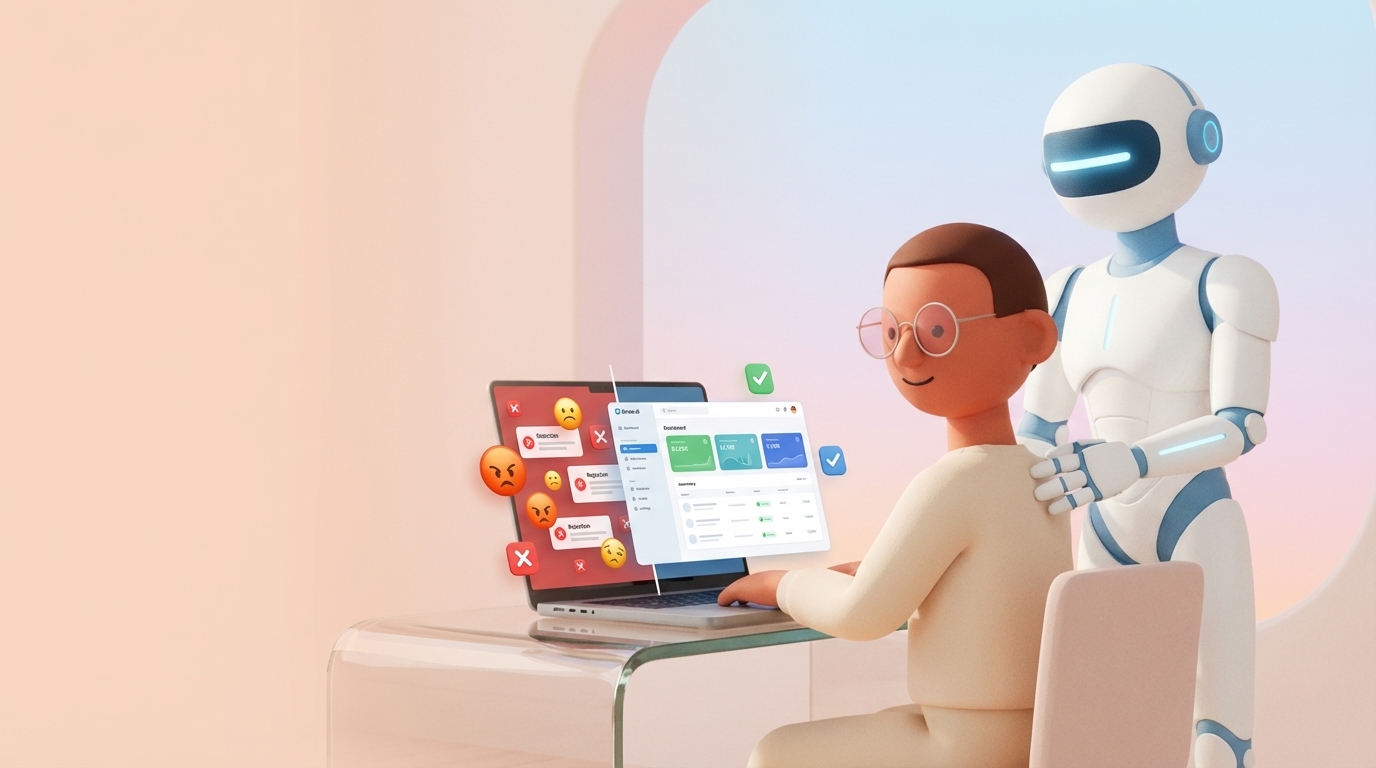
TL;DR: When I analyzed 36 interviews with salespeople about how they use AI, the most surprising finding wasn’t about productivity or pipeline. It was about psychology. Salespeople are using AI as a buffer between themselves and the emotional damage of constant rejection. A founder is hiring humans to read his investor rejections. AEs are running hostile emails through ChatGPT before deciding how to feel about them. This is happening quietly across the industry, and nobody is building for it.
Last year, I published the results of 36 interviews with salespeople about how they use AI. The article covered the obvious stuff — research automation, email drafting, lead scoring. It did well.
But there was one finding I almost didn’t include. Not because it wasn’t interesting, but because it didn’t fit the narrative. The article was about productivity gains and workflow improvements. This finding was about feelings.
Here it is: multiple salespeople told me they use AI as an emotional buffer against rejection.
Not as a tool. As a shield.
The pattern showed up in different forms across multiple interviews. Here are the three most common:
The Hostile Email Translator
A prospect sends a nasty email. Something dismissive, aggressive, or just plain rude. Before AI, the salesperson would read it, feel the sting, and either fire back defensively (bad) or stew for an hour (also bad). Both responses waste time and energy.
Now? They paste the email into an AI tool and ask: “Draft a professional response to this.” The AI doesn’t get offended. It doesn’t take the hostility personally. It generates a calm, professional reply that addresses the prospect’s concerns without matching their energy.
But here’s the insight the salespeople shared that I didn’t expect: the value isn’t in the AI’s response. It’s in the pause.
By the time you’ve copied the email, pasted it, read the AI’s draft, and edited it — 90 seconds have passed. You’ve broken the emotional circuit. You’re no longer reacting. You’re responding. The AI didn’t just write a better email. It gave you 90 seconds of emotional distance.
One AE I interviewed put it simply: “I used to be angry for 20 minutes after a bad email. Now I’m over it in 2 minutes because I’ve already got a draft reply that handles it better than I would have.”
The Rejection Score Normalizer
This one was subtler. Several salespeople described using AI to process batches of outreach responses — running 50 replies through an AI that categorizes them as “interested,” “not now,” “hard no,” or “hostile.” Instead of reading 50 individual rejections (each one a tiny emotional hit), they read a summary: “7 interested, 12 not now, 28 hard no, 3 hostile.”
The rejection is the same. The experience of the rejection is completely different.
When you read “28 hard no,” it’s a data point. When you read 28 individual emails saying “not interested,” “please stop contacting me,” and “we already have a solution” — that’s 28 emotional micro-hits. Same information. Radically different psychological impact.
The Founder Rejection Buffer
This one came from outside sales but illustrates the same principle. I was talking to a founder — experienced operator, built a previous company to $20M ARR — who told me he’d hired a human just to read investor rejection emails during fundraising.
Not to respond. Not to qualify. Just to read them first and filter out the worst ones before they reached his inbox.
Think about that. This is a successful, experienced founder who knows rejection is part of the game. And the emotional toll of reading “no” fifty times a week was severe enough that he paid someone to absorb it.
AI does this cheaper and without the awkwardness of making a human read your rejection mail. Several founders I’ve talked to since have described using email filters + AI summaries to convert individual rejections into batch reports. “12 passes this week” hits differently than reading 12 individual “we’re not moving forward” emails.
Sales has always had an attrition problem. According to Bridge Group data, the average tenure for an SDR is 1.4 years. For AEs, it’s around 2.5 years. The number one reason salespeople leave isn’t money — it’s burnout. And the number one driver of burnout isn’t long hours. It’s the emotional grind of constant rejection.
Cold calling is the worst. If you’ve ever done cold calls — and I have, back in my corporate banking days — you know the feeling. Before you even dial, your body tenses because it knows what’s probably coming. Not the polite “no thank you.” The click. The hostility. The person who’s having a bad day and you happened to be the cold caller who triggered it.
I got sent somewhere unpleasant exactly once during cold calling. Directly and explicitly. That sticks with you in a way that “your quarterly metrics are below target” simply doesn’t.
The traditional answer to this has been “develop a thick skin.” Sales managers talk about resilience, mental toughness, treating rejection as data. All useful. Also insufficient. You can intellectualize rejection all you want — your nervous system still responds to hostility like a threat.
What AI offers isn’t a replacement for emotional resilience. It’s a shock absorber. It doesn’t eliminate the rejection. It changes the interface between the rejection and the salesperson.
Let me describe what I think is actually happening here, because I think the implications go beyond “AI writes better emails.”
In traditional sales, the emotional flow looks like this:
Rejection arrives → salesperson reads it → emotional reaction → pause to recover → craft response → move on to next prospect.
The recovery pause is unpredictable. Sometimes it’s 30 seconds. Sometimes it’s 30 minutes. For a particularly bad interaction, it can color the rest of the day. I’ve had conversations with sales leaders who told me they can tell when one of their reps got a brutal rejection at 10am because their call quality drops for the rest of the afternoon.
With AI as a buffer, the flow changes:
Rejection arrives → AI processes it → salesperson reads summary/draft → micro-reaction → move on.
The critical difference isn’t that the AI is faster. It’s that the AI absorbs the first emotional impact. By the time the salesperson engages with the content, it’s been translated from a hostile personal message into a structured professional exchange. The emotional temperature has been reduced.
I realize this sounds like I’m describing a therapy technique. That’s because I basically am. Cognitive behavioral therapy includes a concept called “cognitive reappraisal” — the practice of changing how you interpret an event rather than changing the event itself. When an AI converts “your product is garbage and you’re wasting my time” into “this prospect has concerns about product fit and prefers not to continue the conversation,” it’s performing cognitive reappraisal on behalf of the salesperson.
Nobody at these AI companies designed this feature intentionally. It’s an emergent behavior that salespeople discovered on their own and quietly incorporated into their workflows. Which is why nobody talks about it — there’s no marketing page for “AI emotional shield.”

I’ve presented this finding to about a dozen sales leaders. Every single one had the same reaction: “That’s interesting, but we need to focus on pipeline metrics.”
And I get it. You can’t put “emotional damage reduced by 40%” on a quarterly review. There’s no dashboard for “psychic toll of rejection.” Sales culture — especially in the US — is built around toughness and metrics. Admitting that your team needs emotional buffering feels like admitting weakness.
But here’s what the data says: the teams with the longest average rep tenure are the teams where reps feel supported. And the most common form of “support” isn’t better comp plans or more enablement content — it’s reducing the parts of the job that make people want to quit.
If AI can reduce the emotional grinding without reducing the number of prospects contacted — which it can, because the volume of outreach stays the same but the volume of raw rejection reading drops — that’s a retention tool, not a productivity tool.
The ROI calculation for AI in sales always focuses on “more pipeline per rep.” I’d argue there’s a second calculation that matters just as much: “how many months longer does each rep stay?”
At $50K+ to recruit and ramp a new SDR, keeping your existing team for an extra 6 months is worth more than a 10% pipeline improvement.
I’m not aware of any AI sales tool — including mine — that explicitly designs for the emotional shield use case. But some design choices accidentally support it:
Batch processing helps. Tools that aggregate responses and present summaries (“12 replies: 3 interested, 7 declined, 2 hostile”) are less emotionally draining than tools that present each reply individually. This is a UI decision that has emotional consequences nobody thought about.
Draft-before-read helps. If your tool generates a draft reply before the salesperson reads the hostile original, they engage with the draft first — which primes them with a professional, measured tone before they see the hostility. This is backwards from how most tools work (read original → draft response) but better for the human.
Aggregate reporting helps. Weekly rejection reports hit differently than daily rejection inboxes. If your AI tool can shift the cadence from “real-time rejection stream” to “daily summary with action items,” you’ve changed the emotional architecture without changing the workflow.
None of these are features you’d see on a comparison page. But they’re the features that determine whether a sales team is still using your tool in month 12 versus month 3.
If AI can shield salespeople from the worst of rejection, should it?
I can hear the objections. “Rejection is how you learn.” “Thick skin is a requirement for sales.” “If they can’t handle rejection, they shouldn’t be in sales.”
Maybe. But we don’t tell surgeons to operate without gloves because “dealing with blood is part of the job.” We don’t tell construction workers to skip the hard hat because “risk is what you signed up for.” We build tools that reduce unnecessary damage while preserving the ability to do the work.
A salesperson who reads an AI summary of 28 rejections still knows they got 28 nos. They still need to adjust their approach, refine their messaging, learn from the patterns. The learning isn’t diminished. The suffering is.
I don’t think we’ll see “emotional wellness” on an AI sales tool pricing page anytime soon. But I do think the tools that accidentally get this right — through better batching, smarter summarization, and human-in-the-loop design that puts the AI between the rejection and the person — will have higher retention and higher NPS than the tools that firehose raw rejection at their users.
And I think that matters more than most people in this industry are willing to admit.
Is this a real finding or just an anecdote? It came up independently in multiple interviews out of 36 total. I didn’t ask about emotional impact — they volunteered it. The consistency across different companies, industries, and seniority levels suggests it’s a real pattern, not a one-off.
Does this apply to inbound sales too? Less directly. Inbound reps deal with fewer hostile interactions because the prospect initiated contact. But inbound teams still face rejection in the qualification phase — telling prospects they don’t qualify, or losing deals after consultation. The emotional buffer principle applies wherever rejection happens.
Can AI actually improve sales team retention? Not proven yet. This would require a controlled study comparing retention rates of teams using AI-buffered workflows versus traditional ones. But the anecdotal signal is strong enough that I think someone should run that study.
Isn’t this just “AI writes emails for me” with extra psychology? The mechanics are the same — AI drafts responses. But the purpose is different when the primary value is emotional distance rather than time savings. A salesperson who uses AI to draft a response in 30 seconds versus 5 minutes is saving time. A salesperson who uses AI to avoid reading a hostile email raw is protecting their capacity to do 50 more calls that day.
How do I implement this for my team without it sounding like “we think you’re too fragile”? Don’t frame it as emotional support. Frame it as efficiency: “We’re implementing AI to batch-process responses so you spend time on interested prospects, not on reading through noise.” The emotional benefit is a side effect that reps will discover and appreciate on their own.
Related reading: How Salespeople Actually Use AI: Insights from 36 Interviews | Snake Oil vs Real AI Sales Tools | Everything Before the First Reply